
The Moment Everyone Missed
On 24 March 2026, Mohamed Salah did something most leaders never do.
The Egyptian King, Liverpool’s third-highest scorer in history and winner of two Premier League titles and a Champions League, posted a video on social media and told the world he would be leaving Anfield at the end of this season. No leaks. No press conference forced by circumstances. No messy contract dispute dragged through the tabloids.
He chose his moment. He told his people first. And he did it with grace.
“Unfortunately, the day has come. This is the first part of my farewell.”
Here is what makes this remarkable. Salah was not a free agent. He had signed a contract extension just twelve months ago, a deal set to run until 2027. A city was counting on him. Millions of supporters built their season around him. And yet he looked at all of that, and he still chose transparency over convenience.
The football world is in shock. But here’s the thing. They are focused on the wrong part of the story.
The real story is not that Salah is leaving.
The real story is how he is leaving.
At 33, he is not fading. He had four goals and four assists in his last nine appearances before injury. He still had plenty to contribute. And yet he made a decision most leaders, in boardrooms and on pitches alike, are too afraid to make.
He decided he was done before anyone else could decide for him.
“I never imagined how deeply this club, this city, these people would become part of my life.”
I Know This Feeling
More than ten years ago, I made the same decision.
I was the CFO of Inovest, a dual-listed investment bank in Bahrain and Kuwait. I had been there for more than eleven years. In that time, I worked with three different Chairmen and five different CEOs. Every single one of them trusted me. I survived every leadership transition. Every restructuring. Every storm.
By any measure, I was at my peak.
I was not being pushed out.
The board trusted me.
My team trusted me.
Nobody was asking me to leave.
And that is exactly why I left.
I will be honest with you.
It was not easy.
I commanded a six-figure salary, bonuses, stock options, and the kind of institutional authority that takes a decade to build.
I was giving all of that up.
People thought I was crazy.
But months before I handed in my resignation, months before I made any announcement, I walked into a bookshop and bought a book titled “Leaving On Top.”
I read it quietly.
I thought about it carefully.
And I made my plan.

On 4 December 2015, I left my corporate life behind.
I walked out of that building as the CFO.
Not as someone who was let go.
Not as someone whose time had passed.
Not as someone who clung to the role until the chair was pulled from under them.
I walked out on my own terms.
The Tension Every Executive Knows
I understand the objection already forming in your mind.
Salah is a footballer.
You are an executive.
You have a board to answer to.
You have obligations to shareholders, to succession pipelines, to teams who depend on your steadiness.
You cannot simply post a video and announce your departure.
You are right.
The mechanics are different.
But the core decision is identical:
Do you write your own ending, or do you wait for someone else to write it for you?
Every senior leader I have ever met knows the feeling I am describing. The moment when the role still fits, but no longer fits perfectly. When you are still delivering, but you sense that your greatest contribution to the organization may now be to create the space for what comes next. When staying starts to feel less like leadership and more like attachment.
That moment is not weakness.
It is intelligence.
The question is whether you have the courage to act on it.
“Liverpool is not just a football club. It is a passion, a history, a spirit.”
Salah said that about a club. But every executive I know could say the same about the organization they gave their best years to. The attachment is real. That is precisely what makes leaving so hard. And precisely what makes leaving well so rare.
The Mountain Taught Me This
On 1 August 2025, I attempted the summit of Mount Elbrus, the highest peak in Europe at 5,642 meters.
I did not summit.
Thirty minutes into the climb, a severe headache set in. I pulled two Panadol tablets from my jacket pocket and hoped they would take the edge off. They did not. Two hours in, the pain was worse. I ran through everything in my mind: a year of preparation, the money invested, the research, the training. And then I made the call to turn back.
Not because the team asked me to. I made it alone. The rest of the team pushed on through a relentless snowstorm and several of them summited. My colleague Musaab Hammadah even raised the Bahraini flag for both of us.
People ask me if that was a failure.
I tell them: absolutely not.
The hardest decision on any mountain is not the decision to push for the summit. Any determined person can push. The hardest decision is to descend, when you still have energy left, when the summit is visible, when every instinct is screaming at you to keep going.
The leaders who make it back are the ones who know the difference between courage and recklessness.
In the boardroom, the same principle applies. The executives who protect their legacy are rarely the ones who pushed the longest. They are the ones who read the conditions accurately, made the call at the right time, and walked away while they could still choose the terms.
Salah did not descend because he was exhausted. He descended because he was still strong enough to choose the moment. That is not weakness. That is wisdom.
The Pattern I Have Watched Play Out
After more than a decade of observing leaders at the highest levels, I have watched this pattern repeat itself more times than I can count.
The executives who leave too late always leave badly. They leave after the whispers begin in the corridors. After the board starts interviewing successors without telling them. After the results dip just enough for everyone to notice the trend. They leave with their confidence shaken and their legacy complicated.
The ones who leave on time, who plan their exit with the same rigor they applied to every other strategic decision, they leave as statesmen.
Their successors revere them.
Their boards recommend them.
Their teams remember them with pride.
The difference is not talent. It is timing. And timing requires the willingness to ask a question that the ego resists:
Have I given this role my best, and is my best now needed somewhere else?
The day I left Inovest, I walked out with my head high. And in the decade since, I have built something I never could have built if I had stayed.
Books. Stages. Mountains.
A life I designed.
None of that happens if I wait for someone to show me the door.
What About You?
You plan three years ahead for every major business decision. You build succession pipelines, manage risk, and think carefully about the legacy you are leaving in every market you enter.
Have you applied that same rigor to your own exit?
Not to quit.
Not to abandon what you have built.
But to think clearly, without ego and without fear, about whether you are still in your current role because you are at your absolute best, or because you have not yet had the courage to imagine what your best looks like in the next chapter.
“Leaving is never easy. You gave me the best time of my life.”
Salah said that to Liverpool.
But it applies to every leader who has ever had to close a chapter they loved.
Know your value.
Know your timing.
Know when to walk away.
Because the bravest thing a leader can sometimes do is not climb higher.
It is to descend with grace, while they still can.
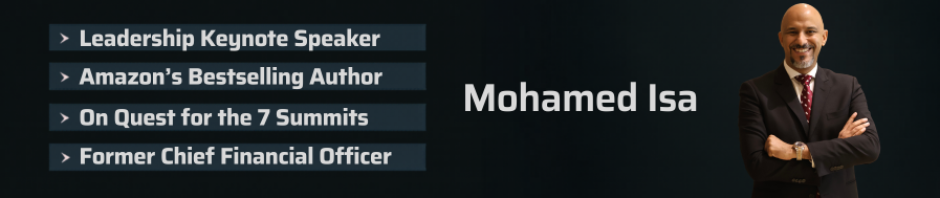
Mohamed Isa is an Amazon Bestselling Author, former CFO of a dual-listed investment bank, and Leadership Keynote Speaker. He connects financial discipline with human performance in every keynote he delivers. He is currently pursuing his PhD at Kathmandu University.
