What the most-watched career in modern sport teaches about standards, reinvention, and the hardest act of all.

Patrice Evra tells a story that I cannot stop thinking about.
After a hard training session, Cristiano Ronaldo invited him home for lunch. Evra arrived tired and hungry, picturing a proper meal. He got salad, plain chicken, and water. No juice. No dessert. He waited for the real food to arrive. It never did. Then Ronaldo stood up and wanted to play two-touch in the garden. After that, the pool. After that, the sauna. There was no rest, because in that house rest was not on the menu.
Evra’s verdict was simple. The man is a machine. He never wants to stop.
Here is the part that matters. This is not a story about football.
Ronaldo was not the most gifted footballer of his generation. Ask the people who watched him at seventeen, and a strange agreement emerges. The genius was not in his feet. It was in what he did with an ordinary Tuesday, and then the next one, for twenty-three years.
He was born poor in Madeira, the youngest of four. He left the island alone at twelve for an academy in Lisbon, homesick and mocked for his accent. At fifteen he had heart surgery that could have ended everything before it began. None of that is a sob story he trades on. It is the raw material for the thing everyone later called obsession. The hunger was not inherited. It was built.
His real record is not 976 goals. It is the number of ordinary days he refused to waste. A standard, repeated daily and enforced without exception, will eventually manufacture the talent everyone assumes you were born with. He did not wait to feel motivated. He built a system that made motivation optional.
Motivation is a mood. A standard is a schedule. One shows up when you feel like it. The other shows up anyway.
The evidence is the boring stuff
The proof is not the highlight reel. It is the small, dull, verifiable material that nobody puts on a poster.
He arrived before training started and stayed after it ended. In England, in Spain, in Italy, for two decades. Teammates in three countries describe the same habit. And a smaller, stranger detail: he has never tattooed his body, and by his own account it is so he can keep donating blood. Nothing about that body was an accident.

And when he lost a game of table tennis to Rio Ferdinand, he did not shrug it off. He bought a table, practiced in private for two weeks, and came back to win.
That is not a footballer’s story. That is an operating principle. Never lose the same way twice, and treat every contest as one you can win with preparation.
Ask yourself an uncomfortable question. Where does your discipline quietly clock off?
Reinvent while you are still winning
Standards explain how he arrived. They do not explain how he stayed for twenty-three years. Staying is a different skill from arriving.
At Real Madrid, as his explosive pace began to fade, he did something most people never do. He changed his game while he was still winning. He moved from the wing into the center and rebuilt himself as the most efficient scorer alive. He did not wait for decline to force a worse version of the change on him. He scheduled it.

I understand that move in my own small way. In 2015, I walked away from the CFO chair while the title still fit, to build a life around speaking, writing, and travel. The lesson reads the same in a boardroom as it does in a penalty box. Reinvent while you are still winning, because the alternative is reinventing when you are forced, and the forced version is always uglier.
There is a stranger habit underneath all of this. A man worth more than a billion dollars, the first in the sport to reach that number, decorated beyond any reasonable measure, is still chasing a round figure of 1,000 goals at 41. He keeps moving his own finish line. Success is the most common cause of decline, because it quietly removes the reason to keep sharpening. He refuses to let it.
Which of your current strengths is quietly expiring?
Now the part that makes it useful
Everything so far is the version that sells posters. Here is the version that earns a room’s respect.
The same intensity that made him unmatched made him hard to be around. Both are true at once. In 2022 he detonated his exit from Manchester United in a television interview, broadcast days before a World Cup, saying he felt betrayed and did not respect his manager. He was often right about the problems. He was wrong about the demolition. Being correct about what is broken does not give you the right to burn the building down on your way out.
But the sharpest lesson came this summer, and it is the one I want to sit with.
At forty-one, Ronaldo became the first player ever to score at six different World Cups. Then, on 6 July 2026, Portugal lost to Spain in the round of 16. A substitute scored in the ninety-first minute. Ronaldo barely touched the ball. His coach, Roberto Martínez, left him on for the full 90 minutes and, afterward, plainly admitted that you simply do not take Cristiano Ronaldo off. Portugal went out. Ronaldo walked the field in tears, then said he left with “a clear conscience.” Martínez called him an exemplary captain and resigned.
Read that again. The most admired man in the squad had become the one his own coach would not bench. Martínez said so plainly afterward: when you need a goal, you do not take Cristiano Ronaldo off. His status had outlived his performance, and the coach could not bring himself to act on the gap.
He could not take himself off. On the mountain, I had to take myself off.
That is the hardest leadership question there is. When does honoring someone’s status start to hurt the very thing they built?
I have been on the other side of that question
Not on a pitch. On a mountain.
On 1 August 2025, two hours up Mount Elbrus, a severe headache set in, and the early signs of altitude sickness came with it. My teammates were strong. They would go on to reach the summit. Musaab Hammadah made it to the top. I did not.
I turned back. Alone. And here is the part that matters. Pushing on could have forced a rescue, and a rescue would have dragged the whole team off the mountain and cost them their summit too. So, I made the call myself. Nobody took me off. I took myself off, so that no one else would have to come down with me.
It is one of the hardest things I have done on any mountain, and it taught me more than the summit would have. Ronaldo’s coach would not take him off. On Elbrus, I took myself off, so my team would not have to. There was no coach, no crowd, and no record to make the call easier. You scrutinize your own body, you count the cost to the people around you, and you decide while you still can.
Hours later, the team reached the top. Musaab came back down and told me he had raised the Bahraini flag for both of us. The flag flew that day. Just not in the hands I had imagined. I did what I could. You cannot control everything, and that is life.
Both of us walked away without the prize. Both of us, I believe, walked away with a clear conscience. The difference is who made the choice, and what that choice protected.

What actually travels
So what carries out of a footballer’s life and into yours? Three things, no more.
1) Pick a few non-negotiable standards and hold them regardless of mood, because motivation will not show up on your worst day and a standard will.
2) Reinvent yourself while your current model still works, not when the market finally forces your hand.
3) Define your win as the effort and the judgment you can account for, so that no single result owns your peace. Then learn the hardest skill of all, which is knowing when to take yourself off.
One warning, because admiration without it is just fan mail. Do not imitate his life. He has chefs, trainers, and near-total control of his schedule. You have a commute, a boss, and people who need you at home. Take the principles. Leave the costume. And remember this: a high standard held without warmth wounds the people you hold to it, and an identity welded entirely to your own output shatters the moment the output dips.
You will not score 976 goals. Neither will I. Neither of us will ever be the machine that Evra met at that strange, foodless lunch.
But tomorrow you will get a Tuesday. And one day, on some mountain of your own, you will have to decide whether the braver act is the summit or the walk back down.
Manufacture the standard. Reinvent before you are forced. Know when to stop.
That is the part worth keeping. Not the goals, not the money, not the following. A clear conscience you actually earned.
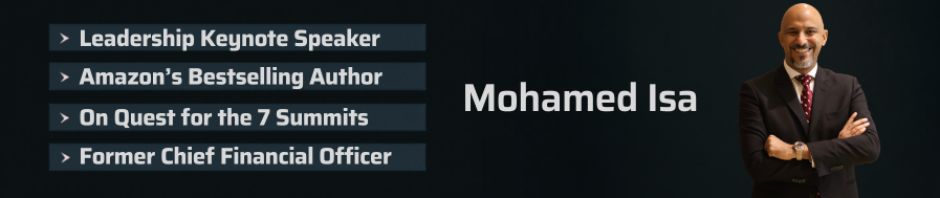
Mohamed Isa is an Amazon Bestselling Author, former CFO, and Leadership Keynote Speaker who shares leadership lessons from mountaineering. He is currently pursuing his PhD at Kathmandu University.