Last Thursday, we did the inside half of self-awareness. This Thursday, we do the outside half. They behave nothing alike.
THIS WEEK’S ALTITUDE
Base Camp: External Perception
At Base Camp, you can see your own gear. You can feel your breathing settle into the altitude. What you cannot see is yourself moving on the ice. Only the team can see that. External Perception works the same way. It is the accurate read on how others actually experience your leadership when you walk into the room. The BOK calls it the second half of self-awareness. Internal Clarity tells you who you are. External Perception tells you who others are following. The gap between the two has a name in the model. The Self-Other Agreement gap. It is the most common failure point at Base Camp. And it does not stay there. It rises.
Tavares was the highest-paid auto CEO in 2023. The architect of the merger that formed Stellantis. By December 2024, his board removed him unanimously after what one source called a “totally untenable” relationship. The diagnosis was not strategy. It was style. Sources told CNBC he cast blame on US executives while ignoring his own mistakes. He saw himself as the operator who delivered the merger. The board, dealers, suppliers, and unions experienced him as brash and disconnected. That is the Self-Other Agreement gap with consequences attached. Stellantis dressed it up in the press release as “different views have emerged.” That phrase, in board language, is what every external perception failure looks like from the outside. The CEO was confident he was right. The room had stopped listening months earlier.
Source: Harvard Business Review, “For Your 360-Degree Feedback to Be Effective, You Need to Discuss It” by Brenda Steinberg (January 2026)
Steinberg opens with a senior leader on the verge of quitting. His career had been built on having a strong voice, challenging others, and “breaking things” so the organization could rebuild. The 360 showed his team experienced exactly that as destructive. Same behavior. Two completely different stories. That is External Perception in three sentences. The BOK predicts this exact pattern. The behaviors that promoted you are the same behaviors others may now be experiencing as toxic. The leader knows what he is doing. The team knows what he is doing too. They just disagree about what he is doing.
THE SUMMIT VIEW
I spent eleven years as a CFO sitting across the table from CEOs who were certain they were clear. Half of them were right. The other half were a board meeting away from finding out otherwise. The pattern has nothing to do with intelligence or experience. It has everything to do with whether the leader has installed the discipline of asking, regularly and from people who will actually answer, “How am I being read in this room?” GCC executives carry an extra weight here. Your boardroom holds Emiratis and Brits and Americans and Indians. Your team holds twenty nationalities on a quiet day. The Self-Other Agreement gap is not one delta. It is a delta per audience. Internal clarity without external perception is half a map. The half that does not show the cliffs.
One question for the weekend. When was the last time you asked someone who works for you to describe how you actually come across? Not how they hope you come across. How you actually do. If the answer makes you uncomfortable, that is the data.
SIGN-OFF
See you at the Summit!
Mohamed Isa
ABOUT THE PEAK LEADERSHIP MODEL
The PLM is a six-level leadership framework, Base Camp through Summit, organized around 21 capability domains. The Body of Knowledge (PLM-BOK) is the reference behind it. The architecture is progressive and cumulative. Skipping levels produces predictable failure.
ABOUT MOHAMED ISA
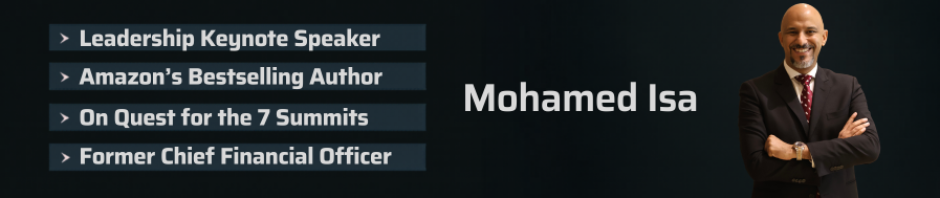
Mohamed Isa is a leadership keynote speaker, an Amazon best-selling author, and a former CFO. He is writing his first Arabic book, Everest: Leadership Lessons, drawing on a century of Everest history to explore what the mountain teaches us about leading under pressure.
SOURCES
1. Reuters / CNBC, “Stellantis CEO Carlos Tavares lost control of the automaker with ‘arrogant’ mistakes, sources say,” December 10, 2024.
The last edition mapped the mountain. This one starts where every climb starts: acclimatizing.
1. This Week’s Altitude
Base Camp: Internal Clarity
At Everest Base Camp, the body makes invisible adjustments before any attempt higher. Red blood cell count rises. Breathing recalibrates. Nothing visible, everything load-bearing. Internal Clarity works the same way. It is an accurate, unflinching read on your own values, motivations, default patterns, and how pressure bends your behavior. The Peak Leadership Body of Knowledge (BOK) refers to it as the internal half of self-awareness. Every capability above Base Camp, communication, team building, strategy, change, legacy, sits on top of it. If this layer is distorted, so is everything built on top of it. And almost everyone distorts it.
2. Field Reports
Source: McKinsey, “How to be an authentic leader” (May 2025)
In a survey of top executives, 57 percent reported that their primary leadership challenge was personal. Not market conditions. Not talent pipelines. Not technology. Personal. McKinsey’s finding maps directly onto the Internal Clarity dimension of Base Camp. When the problem sits inside the leader, no external capability can solve it. The piece frames the answer through Heifetz and Linsky’s “balcony and dance floor” alternation, the trained practice of seeing yourself in action while you act. That is External Self-Awareness feeding Internal Clarity in real time. Most leaders never install the discipline. McKinsey’s 57% tells you what it costs when they don’t.
Source: Harvard Business Review, “Leaders, Bring Your Best Self into the New Year” by Ron Carucci and Tomas Chamorro-Premuzic (January 2026)
Carucci and Chamorro-Premuzic open with statistics worth rereading: Half of senior executives can be expected to fail, despite decades of reliable assessment science. Their diagnosis is the gap between what leaders CAN do and what they do under load. That is Internal Clarity by another name. Their first prescription, “know your ideal aspirational self,” is the exact work the Peak Leadership Model places at Base Camp. No team cohesion, no strategic foresight, no change resilience survives the absence of it. The piece reads like the pre-climb checklist most leaders skip at Base Camp and regret at Camp 3.
Source: Fortune, “Ousted Air Canada CEO Failed to Speak French and Forgot the Basics of Crisis Leadership” (31 March 2026)
Michael Rousseau was given a six-month runway out of Air Canada after a second public reckoning over his inability to speak French. Three hundred hours of training. No measurable progress. A board that saw the red flags in 2021 and blinked. This is the over-estimator pattern at the CEO’s desk. Rousseau’s self-perception that his role did not require fluency in a bilingual country held firm against every external signal. The Self-Other Agreement gap was not narrowing. It had become an identity. The Risk Escalator predicts this exactly: a Base Camp capability gap uncorrected at maturity levels Reactive or Defined produces a public failure at the altitude where no one can still protect you.
3. The Summit View
Here is what none of these pieces says. The higher you climb, the harder the system pushes against internal clarity. Boards reward conviction. Markets reward certainty. The media rewarded the confident soundbite. The same pressure gradient that makes accurate self-perception most necessary at the top is the gradient that quietly punishes it. Every leader I have worked with at altitude knows this in their body, even when they cannot yet name it. Closing the gap is not a feedback problem. Most of these leaders have more feedback than they can process. It is a problem with permission. They have not granted anyone around them the authority to hold up the mirror and keep it there when the reflection gets uncomfortable. So, try this. Name one person in your life with standing permission to tell you that you are wrong. If the name does not come in five seconds, you have your answer.
4. Sign-Off
See you at the Summit!
Mohamed Isa
***
Research Notes
Two findings anchor this edition’s argument, both worth pinning to your office wall.
Tasha Eurich’s research, summarized in Insight (2017) and replicated repeatedly since, found that roughly 95% of leaders believe they are self-aware, and only 10 to 15% are. That gap is the empirical spine of Base Camp.
Atwater and Yammarino (1997) and subsequent literature showed something even sharper. The leaders whose self-ratings exceed how others rate them (the over-estimators) consistently underperform the leaders whose self-ratings come in lower than others’ ratings (the under-estimators). The Peak Leadership Model uses this finding as the Capability Gate Review criterion for the transition from Defined to Integrated Maturity at Base Camp: statistical convergence between your self-ratings and 360-degree feedback, with specific attention to the absence of over-estimation.
If you want to know where you sit, run the 360. Then ask your three closest colleagues to rate the same dimensions. The delta is your starting altitude.
On “Balcony and Dance” Floor
Ronald Heifetz and Marty Linsky introduced the balcony and dance floor in Leadership on the Line (2002). On the dance floor, you are in the music, responding in real time, seeing only what is directly in front of you. From the balcony, the same room reveals patterns: who is leading, where the energy has died, and which couples keep colliding. Both views are real. Neither is sufficient alone. The discipline of leadership is the trained move between them, often inside a single conversation. Most senior leaders never install it. They are the meeting, not the observer of it.
On 5 January 2024, an Alaska Airlines 737 MAX lost a door plug while climbing through 16,000 feet. No one died. But something else broke that day. Boeing’s board. Boeing’s leadership pipeline. Boeing’s century-old reputation for engineering integrity. The company is now on its fourth CEO since the first crash, still fighting to rebuild trust with regulators, customers, and the flying public. Tens of billions of dollars in shareholder value have been destroyed since 2018. And the crises trace back not to 2024, not to the 2018 crashes, but to 1997, when a merger quietly replaced an engineering culture with a financial one.
This is what happens when leaders skip levels.
1. This Week’s Altitude
The Whole Mountain
Welcome to Peak Leadership Week. Every Thursday for the next 24 weeks, I will walk you through one capability domain of the Peak Leadership Model and demonstrate it with real-world news events. Before we climb, you need the map. The model has six levels, drawn from high-altitude mountaineering. Each level addresses a specific organizational requirement. Each level builds on the one below. Skip a level and the consequences surface not at that level, but at the one above it, or the one above that. Boeing did not fail in 2024. Boeing failed in 1997. Every incident since is the Risk Escalator doing its work.
2. The Six Levels
Base Camp. Self-Awareness, Values, Character. The internal operating system. What you actually believe when pressure is real, not what you say in the town hall.
Camp 1. Communication, Decision-Making, Problem-Solving. The ability to read ambiguous signals, make decisions without a script, and give direction people can execute.
Camp 2. Build and Lead Teams Effectively. Shared leadership, psychological safety, collective intelligence. No summit is a solo achievement.
Camp 3. Develop Long-Term Thinking. Cognitive complexity. Systems thinking. The discipline to hold strategic horizons when markets demand quarterly answers.
Camp 4. Navigate Complexity, Drive Change, Build Resilience. When the plan fails and you must operate without one. Contextual diagnosis. Adaptive leadership.
Summit. Leave a Legacy. Institutional value infusion. Succession architecture. What survives after you leave?
Six levels. One altitude logic: progressive, cumulative, unforgiving of shortcuts. You cannot acclimatize your way out of a Base Camp failure at Camp 4. The body knows. The organization knows. Eventually, the public knows.
3. The Summit View
I did not build this model in a classroom. I built it over eleven years as a CFO, watching capable executives fail in predictable patterns. I built it from mountains, where I watched climbers rush the acclimatization protocol and pay for it higher up. And I built it because the leadership literature is full of traits, styles, and personalities, but nothing that explains why one leader rises, and another falls under conditions that look identical from the outside. The answer is altitude logic. It is the reason most leadership development fails. Courage training given to leaders who have not done the Base Camp work produces confident delusion.
Strategic planning given to leaders who cannot read a room produces a confident strategy no one follows. The skills are real. The sequence matters more. For the next twenty-four weeks, I will show you the sequence, one capability at a time. Next Thursday, we plant at Base Camp with Internal Clarity, the foundational capability, illustrated through McKinsey’s latest data, HBR’s January piece, and a public CEO ouster that proves the model’s predictions. By Week 24, you will read a leadership story in the news and know, within seconds, which level cracked first.
One question for the weekend. Every organization has a level that is carrying weight it was never built to carry. Which one is yours?
In March 2003, I attended the Annual Management Meeting for Unilever Arabia in Sharm El Sheikh, Egypt. It was a day to remember. The energy in that room was electric. Colleagues from across the region were gathered in one of the most beautiful settings on the Red Sea, and the mood was a mix of inspiration, fun, and serious purpose.
The HR Team had prepared a few video clips to drive home key messages that were aligned with our corporate values, including Teamwork. They dimmed the lights and played selected scenes from a movie I had never seen before. The sound system in that venue was superb. You did not just hear the movie. You felt the chill from the scenes, the tension in the conversations.
The scenes moved me. I mean, they really moved me.
I could not help it. I turned to my colleague Aiman Kabli from HR and asked him: What is the name of this movie?
He replied: Remember the Titans.
I bought the movie shortly after. I watched it many times. And I still have it in my collection, more than 20 years later. Every time I watch it, I find a new golden nugget.
Why? Because Remember the Titans is not just a movie. It is a master class in five disciplines that every leader must master: leadership, communication, conflict management, team development, and accountability.
The Story Behind the Film
Released in the year 2000, directed by Boaz Yakin, and produced by Jerry Bruckheimer, the film stars the brilliant Denzel Washington as Coach Herman Boone. It is based on a true story. In 1971, T.C. Williams High School in Alexandria, Virginia, was forced to integrate. Black and white students were brought together under one roof for the first time. Coach Boone, an African American, was appointed head coach of the school’s football team, replacing the popular Coach Bill Yoast, played by Will Patton. The real-life players Gerry Bertier and Julius Campbell are portrayed by Ryan Hurst and Wood Harris.
Nobody wanted this to work. The white community was furious. The black community was wary. The players despised each other. And Boone was told, bluntly, that if he lost a single game, he would be fired. Speak of leadership under pressure. At Unilever, we took high performance seriously. Everyone knew the saying: “Shape up or ship out.” Boone was living that reality from day one.
The Titans finished their season undefeated and won the state championship. The film grossed over $136 million worldwide on a $30 million budget. Rotten Tomatoes called it an “inspirational crowd-pleaser with a healthy dose of social commentary.” One reviewer wrote that it “serves as a reminder of how much goodness there is inside people, just waiting for the right person to bring it out.” Another said it should be “shown to every sports team and coach in the country.” And the audience response was even more telling: people did not just watch this film once. They bought it, returned to it, and memorized its lines. I am one of them.
Let me take you inside the five master classes this film delivers.
(c) 2000 – Disney Enterprises, Inc. / Jerry Bruckheimer
1. Leadership: “This Is No Democracy. I Am the Law.”
Coach Boone walked into a situation where the odds were stacked against him. He was unwanted by the school board, resented by the white players, and doubted by the black players who feared he would go soft to gain acceptance.
He was none of those things.
From the very first meeting, Boone set the tone: “We leave for camp: Gettysburg College, August 15th, 7:29 AM. If you show up at 7:30, you will not be playing football this season.” Then he added, “This is no democracy. It is a dictatorship. I am the law.” No ambiguity. No room for negotiation. And not a shred of apology.
When young Gerry Bertier tried to introduce himself casually, Boone shut it down: “And whose team is this, Gerry? Is this your team? Or is this your daddy’s team?” Gerry had no choice but to answer: “Yours.”
Then came the Gettysburg scene. Reviewers have called it one of the greatest motivational speeches in movie history. It is the middle of training camp. Black and white players are still at each other’s throats. Boone wakes the entire team at 3 AM and runs them through dark woods. The players are exhausted, confused, and angry. They do not know where they are going.
Then Boone stops. They are standing at the Gettysburg battlefield cemetery. In the early morning fog, surrounded by the graves of fifty thousand soldiers, he delivers these words:
“Fifty thousand men died right here on this field, fighting the same fight that we’re still fighting amongst ourselves today. This green field right here was painted red, bubbling with the blood of young boys. Listen to their souls, men. If we don’t come together right now on this hallowed ground, we too will be destroyed, just like they were. I don’t care if you like each other or not, but you will respect each other.”
That scene is the turning point of the entire film. Boone did not hand out a policy manual on diversity. He took them to a place where the consequences of hatred were buried in the ground beneath their feet. And he let the dead do the teaching.
Photo by Hulton Archive/Getty Images – (c) 2012
And when opponents tried to intimidate him, he did not flinch: “I don’t scratch my head unless it itches, and I don’t dance unless I hear some music. I will not be intimidated.”
Real leadership is not about being liked. It is about being respected. And respect is earned by holding people to a standard that brings out their best, even when they resist it. How many leaders do you know who water down their standards to avoid conflict? How many managers settle for mediocrity because pushing for excellence is uncomfortable? Boone refused to settle. And that refusal is what turned a group of hostile strangers into state champions.
The breakthroughs in the film did not come from polished speeches or corporate memos. They came from raw, direct, honest conversations between people who had every reason to stay silent.
Photo by Hulton Archive / Getty Images – (c) 2012
Julius Campbell looked the white captain Gerry Bertier straight in the eye and said: “Honesty ain’t too high upon your people’s priority list.” He challenged Gerry: ” You call yourself the captain, but you are letting your teammate Ray miss blocks on purpose to make a black player look bad. And you are doing nothing about it.
Gerry did not want to hear it. But he could not deny it. That single conversation changed the trajectory of the entire team. Because when Gerry finally confronted Ray and demanded better, the message was clear: the standard applies to everyone. No exceptions.
Later, Julius delivers one of the most quoted lines in movie history. When Gerry complains about the team’s attitude, Julius responds calmly:
“Attitude reflects leadership, Captain.”
Seven words. Read them again. They expose the most important truth about teams: the energy, commitment, and attitude of any group are a direct mirror of the person leading it. If your team is disengaged, look in the mirror. If your team lacks trust, look in the mirror. If your team is making excuses, look in the mirror.
In business, we avoid these conversations every day. We send emails when we should be talking face-to-face. We use corporate jargon to soften messages that need to be sharp. We smile in meetings and complain in corridors. The Titans did not have that luxury. They had to say what needed to be said, directly, to the person who needed to hear it. And when they did, things started to change.
3. Conflict Management: The Conflict Was the Curriculum
Coach Boone did not avoid conflict. He engineered it.
The training camp at Gettysburg College was not designed for comfort. It was designed for collision. Forcing black and white players to room together was deliberate. Making each player learn the name, family, and background of a teammate from a different race was deliberate. The grueling three-a-day practices that left no energy for fighting were deliberate. Every single decision at that camp was designed to force people out of their comfort zones and into each other’s lives.
And there were lighter moments woven into the tension. Louie Lastik, the lovable white lineman who genuinely did not care about race, was the first to sit at the black players’ lunch table. When someone questioned him, he said with complete sincerity that he was only eating lunch. And when Coach Boone asked him what he knew about his black roommate, Louie shouted: “Sir, yes, sir! I’m rooming with Blue, sir! And I noticed that he wears those leopard-spotted underwear, sir! Bikini-style, sir!” The camp erupted in laughter. And at that moment, a wall came down.
Most organizations run from conflict. They restructure around it, transfer people away from it, or pretend it does not exist. The Titans story teaches us something different. Conflict, when confronted honestly and with purpose, is the fastest path to trust. The players did not trust each other because someone told them to. They trusted each other because they went through the fire together and came out the other side.
4. Team Development: “Left Side! Strong Side!”
Watch the arc of the team carefully. In the beginning, they cannot stand each other. Black players sit on one side of the bus, white players on the other. They eat separately. They refuse to learn each other’s names. Every interaction is a provocation.
Photo by Hulton Archive / Getty Images – (c) 2012
By the middle of the film, something extraordinary happens. Gerry and Julius, once bitter enemies, develop their own ritual. Before every game, they lock eyes and call out to each other: “Left side!” “Strong side!” Over and over. It becomes their war cry. Their declaration of unity. Reviewers have called it one of the most powerful moments in movie history because it captures the exact instant when unity triumphs over division.
Then comes the scene that breaks your heart. Gerry is paralyzed from the waist down after a devastating car accident. Julius rushes to his hospital room. “You can’t be hurt like this. You’re Superman,” he says, fighting tears. Gerry looks up and replies, “I was afraid of you, Julius. I only saw what I was afraid of. And now I know I was only hating my brother.”
Julius makes a promise: “When all this is over, me and you are gonna move out to the same neighborhood together. And we’ll get old, and we’ll get fat. And there ain’t gonna be all this black-white between us.”
From the hospital bed, Gerry smiles: “Left side.” And Julius, standing at the door: “Strong side.”
If that does not move you, check your pulse.
That transformation did not happen because of one heroic moment. It happened through daily acts of commitment, vulnerability, and shared sacrifice. It happened because Coach Boone forced them to see each other as individuals, not as colors. And it happened because suffering has a way of stripping away everything except what is real. I have led teams in my corporate life. I know what it takes to bring people together who do not naturally belong together. It takes patience. It takes relentless consistency. And it takes a leader willing to endure short-term unpopularity to build something extraordinary in the long term.
5. Accountability: “This Team Is Perfect”
Accountability is the thread that ties the entire film together. And the Titans show us that it is not a one-way street. It flows downward, sideways, and upward.
Downward: When Gerry finally accepted that his teammate, Ray, had been deliberately missing blocks to sabotage a black player, he went to Coach Boone and said, “I want Ray off the team, Coach.” Boone reminded him of the policy. Gerry stood firm: “I know Ray missed that block on purpose.” And Boone’s response was masterful: “You’re the captain. You make your decision, but you support that decision.”
That is how you build accountability in a team. You give people the authority to make hard calls, and you hold them to the consequences. Gerry did not pass the problem upward and hoped it would go away. He owned it. And by removing the one player who was poisoning the team’s unity, he sent a message louder than any speech: no talent is worth more than the team’s integrity.
Sideways: Coach Yoast held the referees accountable when he discovered they were rigging the semi-final game against the Titans. The school board had offered to reinstate him as head coach and induct him into the Hall of Fame if the Titans lost. He could have stayed quiet and reclaimed everything he had lost. Instead, he confronted the head referee:
“You call this game fair, or I’m going to the papers. I don’t care if I go down with you. But before God, I swear I’ll see every last one of you thrown in jail.”
Then he turned to his players and unleashed the most spine-tingling speech in the film: “I don’t want them to gain another yard! You blitz all night! If they cross the line of scrimmage, I’m gonna take every last one of you out! You make sure they remember, FOREVER, the night they played the Titans! LEAVE NO DOUBT!”
No Credit Details Available
The man who had been quiet the entire film finally roared. And his team responded with the greatest defensive performance of their season. He gave up the Hall of Fame to do what was right. That is integrity in action.
And upward: in the most stunning moment of accountability in the film, Julius Campbell held Coach Boone himself to his own standard. Before the championship game, Boone tried to ease the pressure: “Win or lose, we’re gonna walk out of this stadium tonight with our heads held high.”
Julius stepped forward:
“No, it ain’t, Coach. With all due respect, you demanded more of us. You demanded perfection. Now, I ain’t saying that I’m perfect, ’cause I’m not. And I ain’t gonna never be. None of us are. But we have won every single game we have played till now. So this team is perfect. We stepped out on that field that way tonight. And, if it’s all the same to you, Coach Boone, that’s how we want to leave it.”
The student had surpassed the teacher. The man who was taught to demand excellence was now being held to his own standard by the very people he had pushed. That is the highest form of accountability: when the culture you build holds you accountable to itself.
A Film That Transcends Sport
The real Coach Herman Boone passed away in December 2019 at the age of 84. The real Julius Campbell passed away in January 2019 at 65. The real Gerry Bertier died in 1981 at just 27. The gymnasium at T.C. Williams High School was renamed in his honor. Julius and Gerry remained close friends until Gerry’s death.
The film’s instrumental score, “Titans Spirit” by Trevor Rabin, took on a life of its own. NBC used it during the closing credits of multiple Olympic Games from 2002 onwards. It was played at the New York Yankees’ World Series ring ceremony. And it was played at Barack Obama’s 2008 victory celebration. Music, like leadership, has a way of outliving the moment that created it.
And the film’s closing narration, delivered by young Sheryl Yoast, remains one of the most beautiful lines in cinema:
“People say that it can’t work, black and white. Here, we make it work every day. We still have our disagreements, of course, but before we reach for hate, always, always, we remember the Titans.”
I have watched this film several times over 23 years. And every time, I see something new. A line that hits harder because of what I am going through. A scene that mirrors a challenge I am facing with my own team or career. A moment that reminds me why leadership matters.
The film was released in the year 2000, but its lessons are timeless. They apply in the boardrooms of Bahrain, the startups of Riyadh, the factories of Mumbai, and the classrooms of Alexandria, Virginia. Wherever there are people who are different from each other and must come together for a common purpose, the Titans story is relevant.
If you have not seen it, buy it. If you have seen it, watch it again. And this time, do not just watch it as entertainment. Watch it as a leader. Study it. Discuss it with your team. Ask yourself the hard questions: Am I setting the standard, or am I settling? Am I having honest conversations, or am I avoiding them? Am I walking into conflict, or running from it? Am I holding people accountable, and am I inviting them to hold me accountable in return?
Be bold. Be honest. Be the coach your team needs you to be.
• • •
Mohamed Isa is an Amazon Bestselling Author, former CFO, and Leadership Keynote Speaker who shares leadership lessons from mountaineering. He is currently pursuing his PhD at Kathmandu University.
5,364 meters. Thin air. Every step felt like moving through quicksand.
The bitter wind cut through my gear. Exhaustion whispered doubts in my ear. And the mountain, in its magnificent indifference, did not care what title was on my business card.
It was May 2022. I was trekking to Everest Base Camp. Before that trek, I had spent over two decades in corporate life. CFO of a listed investment bank. Board member in different companies. Enough spreadsheets to wallpaper the Burj Khalifa. The mountain was not impressed.
Before we set out from Kathmandu, I did what I always do before a journey: I went looking for books. In a shop off Thamel, the kind of place that smells of old paper and incense, I picked up five of them, along with fridge magnets, patches, coins, stamps, scarves. The usual things you collect when you know a place is going to matter.
One title stopped me the moment I read the spine.
No Shortcuts to the Top. By Ed Viesturs.
I was blown away! In a world obsessed with shortcuts and hacks, here was a direct challenge: it takes time to do great things. Viesturs spent eighteen years climbing the world’s fourteen highest peaks without supplemental oxygen. No shortcuts. No artificial aids. Just the mountain, the conditions, and principles he refused to compromise.
The principle that has stayed with me longest is this:
Getting to the top is optional.
Getting down is mandatory.
From Base Camp to the Boardroom
Viesturs is the first American to summit all fourteen 8,000-meter peaks without bottled oxygen. His eighteen-year campaign produced a 67% summit success rate across 31 Himalayan expeditions. That is not a record of failure. It is the result of one deliberate philosophy: Protecting the team’s capacity to return was always more important than reaching any single peak.
His central concept is the Round-Trip. The summit is not the finish line. It is the halfway point. Every plan that does not account for the descent is incomplete. As he puts it:
“The mountain decides whether you climb or not. The art of mountaineering is knowing when to go, when to stay, and when to retreat.”
Every leader I have encountered knows how to push toward a goal. The GCC’s executive culture is built on it. Vision, ambition, speed. Reach the target, announce the win, move to the next one.
What very few are trained for is what happens after the summit.
The descent is where most mountaineering accidents occur. Roughly 80% of fatalities on high-altitude peaks happen on the way down. When the psychological reward of the summit causes people to relax, reserves are depleted, and focus drops precisely at the moment the mountain is most dangerous.
That same pattern plays out in boardrooms, on project close-outs, and in post-merger integrations. The summit was reached. The round trip was not planned for.
The GCC Executive and the Completion Illusion
There is a specific pressure in the GCC’s executive environment that makes this failure mode acute. I have seen it from the inside. As CFO of a listed investment bank for over a decade and later as a board member at multiple companies, I watched this pattern repeat itself with remarkable consistency. Delivery cycles are fast. Ambitious national transformation agendas, rapid regional expansion, and intense shareholder expectations create a culture that celebrates the milestone and moves immediately to the next horizon.
A major deal closes, and the team is immediately redeployed before anyone has had a chance to consolidate or extract lessons. A transformation program hits Year 1 KPIs, and the sponsoring executive declares victory, withdrawing resources needed to embed the change. A strategy offsite produces a compelling new direction, and three months later, the organization is still running the old one because no one planned the implementation descent.
The most acute version of this is in listed and public companies. The entire leadership agenda gets compressed into one question: What will investors say about this quarter? Not whether we are building something sustainable. Not whether the team has the capacity to deliver next year. Just the number, right now. The summit. The descent is someone else’s problem.
Leaders are rewarded for getting to the top. Nobody measures whether they got back safely.
This is not a personal failing. It is a structural one. And it is precisely what Viesturs spent eighteen years solving on the mountain.
The Round-Trip Principle: A Camp 3 Framework
In the Peak Leadership Model, Camp 3 is where strategic leadership is developed. It is where cognitive complexity either grows or stalls, and where capable operational leaders plateau because they have never been asked to think beyond the summit.
The Round-Trip Principle draws directly on Viesturs’ operating logic: every ascent plan must contain an equally rigorous descent plan. Resources, energy, and team morale are not spent getting to the top. They are budgeted to ensure the whole team returns capable of climbing again.
In practice, this means three things.
Summit fever is the real threat. In 1996, Viesturs was on Everest as part of the IMAX filming expedition when eight climbers died in a single day. The cause was not incompetence. It was summit fever: the irrational momentum that builds when a goal is close, and people override their own judgment. Climbers summited after 3:30 PM, well past the designated turnaround time, with a storm already building on the upper mountain. Viesturs’ team sensed the conditions were wrong and turned around. While other teams pressed on, the IMAX team descended to Camp II and, from that position, rendered aid when the crisis unfolded above them. The discipline to stop was not a weakness. It was what made them useful when it mattered. Viesturs later distilled that decision to its essence:
“Listen to your instincts. Don’t get caught up in groupthink.”
For a senior leader, summit fever looks like this: the board presentation is in three days, so you push the team through another weekend; the acquisition closes this quarter, so you skip integration planning; the KPI is within reach, so you authorize a decision that hits the number but quietly breaks something structural. You reach the summit. The mountain takes note. And Viesturs is clear on what that means:
“A mistake is a mistake even if you get away with it.”
The turnaround time must be a hard constraint, not a guideline. Viesturs set turnaround times and held them regardless of progress. Not because he lacked ambition, but because he knew the conditions for reaching a summit on a given day were entirely separate from the conditions for surviving to climb again. For GCC leaders navigating multi-year transformation programs or extended market cycles, the pre-committed turnaround is one of the highest-leverage disciplines available.
A non-summit is not a failure. Viesturs called unsuccessful summit attempts “non-successes.” Not failures. The distinction matters. Failure carries shame and triggers defensive behavior. A non-success is data: conditions were not right today, the mountain will be there again. His 67% summit rate was deliberately maintained because protecting the capability to return mattered more than any single peak.
Leaders who cannot frame a strategic retreat as a deliberate act of stewardship will always overspend on the ascent and arrive at the summit with nothing left for the descent.
Actionable Takeaway
At Base Camp: know your current pattern. Before your next major initiative, honestly audit your last three completions. Did your team have enough left when it was over? Were lessons extracted or buried in the next sprint? Viesturs defines the standard every leader should hold:
“Teamwork is an implicit trust in, and recognition that the person next to you is No. 1.”
That is the audit. Not how many tasks were completed. But whether you showed up for the person next to you. Self-awareness starts there.
On the Ascent: design the descent before you leave. For every goal, define the round-trip explicitly: what resources are reserved for consolidation, who owns the integration phase, and what the recovery plan looks like after the peak is reached. Build the descent into the plan before the ascent begins.
At the Summit: make “non-success” a legitimate outcome. Give your team explicit permission to name a turnaround moment without coding it as failure. Define your pre-committed decision criteria: the conditions under which you will stop, recalibrate, and return stronger. Leaders who can do this will outlast and outperform those who cannot.
The View from the Other Side
That trek to Everest Base Camp in May 2022 changed my life. I came back Everestized, as I call it. The mountain did that. Not in spite of the difficulty, but because of it.
What Viesturs gave me was a framework for what the mountain had already shown me. No shortcuts to the top. And getting to the top is only half the journey.
The point was the round trip. The point was to return capable of going again by protecting the one resource no expedition can replace: the team.
As you look at the next summit in your own leadership journey, the next deal, the next transformation, ask yourself one honest question.
Have you planned the descent?
Because the mountain does not care how ambitious you are. It does not care about your quarterly targets or your investor presentations.
Plan the descent.
Protect the team.
Build something that lasts!
Mohamed Isa is a leadership keynote speaker, an Amazon best-selling author, and a former CFO. He is writing his first Arabic book, Everest: Leadership Lessons, drawing on a century of Everest history to explore what the mountain teaches us about leading under pressure.
On June 23, 2016, I stood on a stage at the Bahrain Society of Engineers, Bahrain, holding three white towels.
The hall was packed. Eight speakers had gathered for a tribute event titled Muhammad Ali: The Voice of Peace and Love. The event was curated by Y-Access, a company founded by my longtime friend and fellow international speaker, Mohamed Ali Shukri. The Greatest had died twenty days earlier, and no one in that room was over it. The energy filled the biggest hall in the building and more. No one wanted to leave that night.
I held up the first towel. I told the audience, “You can throw this one away.” It means you gave up.
I held up the second towel. I said, “You can pass this one to someone who needs it.” To wipe the sweat. To wipe the blood.
I held up the third towel. I said: This one, I keep for myself. For when I need it.
Three towels. Three choices every leader faces. And Muhammad Ali’s life illustrates all three.
Throwing a white towel to the audience.
Towel One: The One You Throw Away
In boxing, the white towel is the universal symbol of surrender. When a corner throws it into the ring, the fight is over. The fighter is done.
On April 28, 1967, the most famous athlete on the planet was asked to throw his towel.
Muhammad Ali, the reigning heavyweight champion of the world, refused to be drafted into the United States military during the Vietnam War. He showed up at the induction center in Houston. His name was called. He did not step forward. It was called again. He stood still. A third time. Nothing. An officer warned him that he was committing a felony punishable by five years in prison and a $10,000 fine. Ali did not move.
That same day, the New York State Athletic Commission suspended his boxing license. The World Boxing Association stripped him of his title. He was 25 years old, at the absolute peak of his powers, and he lost everything in a single afternoon.
Think about that for a moment. He could have complied. He could have served quietly, returned to boxing, and resumed his career with his earnings, his title, and his reputation intact. The easier path was right in front of him. He chose the harder one.
Ali did not fight again for over three years. Three and a half years of his athletic prime, gone. Not because he lost a fight, but because he refused to abandon his principles.
Leadership Lesson # 1: How many executives throw their towel every day without realizing it? They compromise a value to protect a title. They stay silent in a meeting when they know something is wrong. They sign off on a decision they disagree with because the cost of speaking up feels too high. Every time you say yes when your conscience says no, you are throwing the towel. Ali’s message was simple: the towel stays in your hand until you decide to let it go. Not your boss. Not your board. Not the crowd.
Having fun with Mohamed Ali Shukri.
Towel Two: The One You Pass to Someone Else
On July 19, 1996, three billion people watched a man with trembling hands light the Olympic cauldron in Atlanta.
Ali had been diagnosed with Parkinson’s disease twelve years earlier. The athlete who once moved faster than any heavyweight in history could barely hold the torch steady. Swimmer Janet Evans passed him the flame, and for a few agonizing seconds, it looked like the fire might burn his arms before the mechanism caught. The stadium held its breath.
Then the cauldron lit. And the crowd erupted: Ali, Ali, Ali.
That moment was not about glory. It was about service. Ali spent the final three decades of his life passing towels. He co-founded the Muhammad Ali Parkinson Center in Phoenix. He traveled to Iraq in 1990 and negotiated the release of fifteen American hostages. He became a United Nations Messenger of Peace. He received the Presidential Medal of Freedom in 2005. And in that stadium in Atlanta, he held a flame for the world, not for himself.
At our tribute event in Bahrain, the proceeds supported people with special needs. That was Ali’s fingerprint, even in death. The event was never about remembering a boxer. It was about continuing what he started.
Leadership Lesson # 2: The best leaders are not the ones who hold on to everything. They are the ones who pass the towel. They mentor the person behind them. They fund the cause that outlives them. They share credit, knowledge, and opportunity. When you pass your towel to someone who needs it, you do not lose anything. You multiply.
A picture I took in a museum in Prague, Czech Republic
Towel Three: The One You Keep for Yourself
In 1964, Cassius Marcellus Clay Jr. became Muhammad Ali.
The backlash was ferocious. Sportswriters refused to use his new name for years. The establishment mocked him. Fans turned against him. But Ali never wavered. His name was not a brand exercise or a publicity stunt. It was his identity. His faith. His truth.
When the court convicted him of refusing the draft, the official record read “Clay v. United States.” They would not even grant him his name in their paperwork. It did not matter. The world knew who he was. And on June 28, 1971, the Supreme Court unanimously overturned his conviction.
Ali kept one towel for himself. His identity. His values. His sense of who he was, regardless of what the world demanded he become. He never traded that towel for applause, for money, or for an easier life.
Leadership Lesson # 3: Leaders who give everything away eventually have nothing left to lead with. You need a towel; you do not hand it over. Your non-negotiable. The principle you protect even when protecting it costs you. For Ali, it was his faith and his name. For you, it might be your integrity, your word, or the standard you refuse to lower, no matter how much pressure comes from above. Without that towel, you are performing leadership. You are not practicing it.
Ali visited Bahrain once, in 1972, on a stopover during his pilgrimage to Hajj. Hundreds of fans greeted him at the airport. Senior officials received him. Forty-four years later, eight speakers stood in a hall in Juffair, Bahrain, and tried to put into words what he meant to the world.
I do not remember everything I said that night. But ten years later, I still remember the three towels in my hands. And I still remember the question I left the audience with.
It is the same question I leave you with now.
Which towel are you holding?
Mohamed Isa is a 5-Time Amazon Bestselling Author, former executive, and Leadership Keynote Speaker who shares leadership lessons from mountaineering. He is currently pursuing his PhD at Kathmandu University.