
No Shortcuts
5,364 meters. Thin air. Every step felt like moving through quicksand.
The bitter wind cut through my gear. Exhaustion whispered doubts in my ear. And the mountain, in its magnificent indifference, did not care what title was on my business card.
It was May 2022. I was trekking to Everest Base Camp. Before that trek, I had spent over two decades in corporate life. CFO of a listed investment bank. Board member in different companies. Enough spreadsheets to wallpaper the Burj Khalifa. The mountain was not impressed.
Before we set out from Kathmandu, I did what I always do before a journey: I went looking for books. In a shop off Thamel, the kind of place that smells of old paper and incense, I picked up five of them, along with fridge magnets, patches, coins, stamps, scarves. The usual things you collect when you know a place is going to matter.
One title stopped me the moment I read the spine.
No Shortcuts to the Top. By Ed Viesturs.
I was blown away! In a world obsessed with shortcuts and hacks, here was a direct challenge: it takes time to do great things. Viesturs spent eighteen years climbing the world’s fourteen highest peaks without supplemental oxygen. No shortcuts. No artificial aids. Just the mountain, the conditions, and principles he refused to compromise.
The principle that has stayed with me longest is this:
Getting to the top is optional.
Getting down is mandatory.
From Base Camp to the Boardroom
Viesturs is the first American to summit all fourteen 8,000-meter peaks without bottled oxygen. His eighteen-year campaign produced a 67% summit success rate across 31 Himalayan expeditions. That is not a record of failure. It is the result of one deliberate philosophy: Protecting the team’s capacity to return was always more important than reaching any single peak.
His central concept is the Round-Trip. The summit is not the finish line. It is the halfway point. Every plan that does not account for the descent is incomplete. As he puts it:
“The mountain decides whether you climb or not. The art of mountaineering is knowing when to go, when to stay, and when to retreat.”
Every leader I have encountered knows how to push toward a goal. The GCC’s executive culture is built on it. Vision, ambition, speed. Reach the target, announce the win, move to the next one.
What very few are trained for is what happens after the summit.
The descent is where most mountaineering accidents occur. Roughly 80% of fatalities on high-altitude peaks happen on the way down. When the psychological reward of the summit causes people to relax, reserves are depleted, and focus drops precisely at the moment the mountain is most dangerous.
That same pattern plays out in boardrooms, on project close-outs, and in post-merger integrations. The summit was reached. The round trip was not planned for.
The GCC Executive and the Completion Illusion
There is a specific pressure in the GCC’s executive environment that makes this failure mode acute. I have seen it from the inside. As CFO of a listed investment bank for over a decade and later as a board member at multiple companies, I watched this pattern repeat itself with remarkable consistency. Delivery cycles are fast. Ambitious national transformation agendas, rapid regional expansion, and intense shareholder expectations create a culture that celebrates the milestone and moves immediately to the next horizon.
A major deal closes, and the team is immediately redeployed before anyone has had a chance to consolidate or extract lessons. A transformation program hits Year 1 KPIs, and the sponsoring executive declares victory, withdrawing resources needed to embed the change. A strategy offsite produces a compelling new direction, and three months later, the organization is still running the old one because no one planned the implementation descent.
The most acute version of this is in listed and public companies. The entire leadership agenda gets compressed into one question: What will investors say about this quarter? Not whether we are building something sustainable. Not whether the team has the capacity to deliver next year. Just the number, right now. The summit. The descent is someone else’s problem.
Leaders are rewarded for getting to the top. Nobody measures whether they got back safely.
This is not a personal failing. It is a structural one. And it is precisely what Viesturs spent eighteen years solving on the mountain.
The Round-Trip Principle: A Camp 3 Framework
In the Peak Leadership Model, Camp 3 is where strategic leadership is developed. It is where cognitive complexity either grows or stalls, and where capable operational leaders plateau because they have never been asked to think beyond the summit.
The Round-Trip Principle draws directly on Viesturs’ operating logic: every ascent plan must contain an equally rigorous descent plan. Resources, energy, and team morale are not spent getting to the top. They are budgeted to ensure the whole team returns capable of climbing again.
In practice, this means three things.
Summit fever is the real threat. In 1996, Viesturs was on Everest as part of the IMAX filming expedition when eight climbers died in a single day. The cause was not incompetence. It was summit fever: the irrational momentum that builds when a goal is close, and people override their own judgment. Climbers summited after 3:30 PM, well past the designated turnaround time, with a storm already building on the upper mountain. Viesturs’ team sensed the conditions were wrong and turned around. While other teams pressed on, the IMAX team descended to Camp II and, from that position, rendered aid when the crisis unfolded above them. The discipline to stop was not a weakness. It was what made them useful when it mattered. Viesturs later distilled that decision to its essence:
“Listen to your instincts. Don’t get caught up in groupthink.”
For a senior leader, summit fever looks like this: the board presentation is in three days, so you push the team through another weekend; the acquisition closes this quarter, so you skip integration planning; the KPI is within reach, so you authorize a decision that hits the number but quietly breaks something structural. You reach the summit. The mountain takes note. And Viesturs is clear on what that means:
“A mistake is a mistake even if you get away with it.”
The turnaround time must be a hard constraint, not a guideline. Viesturs set turnaround times and held them regardless of progress. Not because he lacked ambition, but because he knew the conditions for reaching a summit on a given day were entirely separate from the conditions for surviving to climb again. For GCC leaders navigating multi-year transformation programs or extended market cycles, the pre-committed turnaround is one of the highest-leverage disciplines available.
A non-summit is not a failure. Viesturs called unsuccessful summit attempts “non-successes.” Not failures. The distinction matters. Failure carries shame and triggers defensive behavior. A non-success is data: conditions were not right today, the mountain will be there again. His 67% summit rate was deliberately maintained because protecting the capability to return mattered more than any single peak.
Leaders who cannot frame a strategic retreat as a deliberate act of stewardship will always overspend on the ascent and arrive at the summit with nothing left for the descent.
Actionable Takeaway
At Base Camp: know your current pattern. Before your next major initiative, honestly audit your last three completions. Did your team have enough left when it was over? Were lessons extracted or buried in the next sprint? Viesturs defines the standard every leader should hold:
“Teamwork is an implicit trust in, and recognition that the person next to you is No. 1.”
That is the audit. Not how many tasks were completed. But whether you showed up for the person next to you. Self-awareness starts there.
On the Ascent: design the descent before you leave. For every goal, define the round-trip explicitly: what resources are reserved for consolidation, who owns the integration phase, and what the recovery plan looks like after the peak is reached. Build the descent into the plan before the ascent begins.
At the Summit: make “non-success” a legitimate outcome. Give your team explicit permission to name a turnaround moment without coding it as failure. Define your pre-committed decision criteria: the conditions under which you will stop, recalibrate, and return stronger. Leaders who can do this will outlast and outperform those who cannot.
The View from the Other Side
That trek to Everest Base Camp in May 2022 changed my life. I came back Everestized, as I call it. The mountain did that. Not in spite of the difficulty, but because of it.
What Viesturs gave me was a framework for what the mountain had already shown me. No shortcuts to the top. And getting to the top is only half the journey.
The point was the round trip. The point was to return capable of going again by protecting the one resource no expedition can replace: the team.
As you look at the next summit in your own leadership journey, the next deal, the next transformation, ask yourself one honest question.
Have you planned the descent?
Because the mountain does not care how ambitious you are. It does not care about your quarterly targets or your investor presentations.
Plan the descent.
Protect the team.
Build something that lasts!

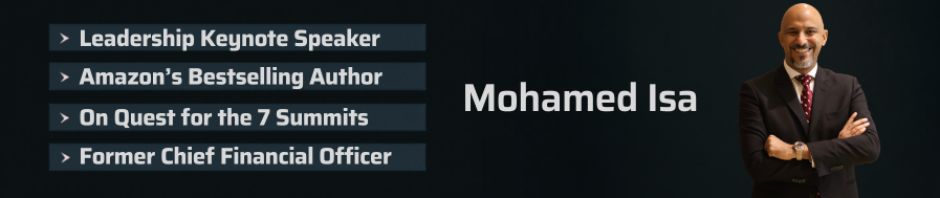
Mohamed Isa is a leadership keynote speaker, an Amazon best-selling author, and a former CFO. He is writing his first Arabic book, Everest: Leadership Lessons, drawing on a century of Everest history to explore what the mountain teaches us about leading under pressure.
