
In March 2003, I attended the Annual Management Meeting for Unilever Arabia in Sharm El Sheikh, Egypt. It was a day to remember. The energy in that room was electric. Colleagues from across the region were gathered in one of the most beautiful settings on the Red Sea, and the mood was a mix of inspiration, fun, and serious purpose.
The HR Team had prepared a few video clips to drive home key messages that were aligned with our corporate values, including Teamwork. They dimmed the lights and played selected scenes from a movie I had never seen before. The sound system in that venue was superb. You did not just hear the movie. You felt the chill from the scenes, the tension in the conversations.
The scenes moved me. I mean, they really moved me.
I could not help it. I turned to my colleague Aiman Kabli from HR and asked him: What is the name of this movie?
He replied: Remember the Titans.
I bought the movie shortly after. I watched it many times. And I still have it in my collection, more than 20 years later. Every time I watch it, I find a new golden nugget.
Why? Because Remember the Titans is not just a movie. It is a master class in five disciplines that every leader must master: leadership, communication, conflict management, team development, and accountability.
The Story Behind the Film
Released in the year 2000, directed by Boaz Yakin, and produced by Jerry Bruckheimer, the film stars the brilliant Denzel Washington as Coach Herman Boone. It is based on a true story. In 1971, T.C. Williams High School in Alexandria, Virginia, was forced to integrate. Black and white students were brought together under one roof for the first time. Coach Boone, an African American, was appointed head coach of the school’s football team, replacing the popular Coach Bill Yoast, played by Will Patton. The real-life players Gerry Bertier and Julius Campbell are portrayed by Ryan Hurst and Wood Harris.
Nobody wanted this to work. The white community was furious. The black community was wary. The players despised each other. And Boone was told, bluntly, that if he lost a single game, he would be fired. Speak of leadership under pressure. At Unilever, we took high performance seriously. Everyone knew the saying: “Shape up or ship out.” Boone was living that reality from day one.
The Titans finished their season undefeated and won the state championship. The film grossed over $136 million worldwide on a $30 million budget. Rotten Tomatoes called it an “inspirational crowd-pleaser with a healthy dose of social commentary.” One reviewer wrote that it “serves as a reminder of how much goodness there is inside people, just waiting for the right person to bring it out.” Another said it should be “shown to every sports team and coach in the country.” And the audience response was even more telling: people did not just watch this film once. They bought it, returned to it, and memorized its lines. I am one of them.
Let me take you inside the five master classes this film delivers.

1. Leadership: “This Is No Democracy. I Am the Law.”
Coach Boone walked into a situation where the odds were stacked against him. He was unwanted by the school board, resented by the white players, and doubted by the black players who feared he would go soft to gain acceptance.
He was none of those things.
From the very first meeting, Boone set the tone: “We leave for camp: Gettysburg College, August 15th, 7:29 AM. If you show up at 7:30, you will not be playing football this season.” Then he added, “This is no democracy. It is a dictatorship. I am the law.” No ambiguity. No room for negotiation. And not a shred of apology.
When young Gerry Bertier tried to introduce himself casually, Boone shut it down: “And whose team is this, Gerry? Is this your team? Or is this your daddy’s team?” Gerry had no choice but to answer: “Yours.”
Then came the Gettysburg scene. Reviewers have called it one of the greatest motivational speeches in movie history. It is the middle of training camp. Black and white players are still at each other’s throats. Boone wakes the entire team at 3 AM and runs them through dark woods. The players are exhausted, confused, and angry. They do not know where they are going.
Then Boone stops. They are standing at the Gettysburg battlefield cemetery. In the early morning fog, surrounded by the graves of fifty thousand soldiers, he delivers these words:
“Fifty thousand men died right here on this field, fighting the same fight that we’re still fighting amongst ourselves today. This green field right here was painted red, bubbling with the blood of young boys. Listen to their souls, men. If we don’t come together right now on this hallowed ground, we too will be destroyed, just like they were. I don’t care if you like each other or not, but you will respect each other.”
That scene is the turning point of the entire film. Boone did not hand out a policy manual on diversity. He took them to a place where the consequences of hatred were buried in the ground beneath their feet. And he let the dead do the teaching.

And when opponents tried to intimidate him, he did not flinch: “I don’t scratch my head unless it itches, and I don’t dance unless I hear some music. I will not be intimidated.”
Real leadership is not about being liked. It is about being respected. And respect is earned by holding people to a standard that brings out their best, even when they resist it. How many leaders do you know who water down their standards to avoid conflict? How many managers settle for mediocrity because pushing for excellence is uncomfortable? Boone refused to settle. And that refusal is what turned a group of hostile strangers into state champions.
2. Communication: “Attitude Reflects Leadership, Captain”
The breakthroughs in the film did not come from polished speeches or corporate memos. They came from raw, direct, honest conversations between people who had every reason to stay silent.

Julius Campbell looked the white captain Gerry Bertier straight in the eye and said: “Honesty ain’t too high upon your people’s priority list.” He challenged Gerry: ” You call yourself the captain, but you are letting your teammate Ray miss blocks on purpose to make a black player look bad. And you are doing nothing about it.
Gerry did not want to hear it. But he could not deny it. That single conversation changed the trajectory of the entire team. Because when Gerry finally confronted Ray and demanded better, the message was clear: the standard applies to everyone. No exceptions.
Later, Julius delivers one of the most quoted lines in movie history. When Gerry complains about the team’s attitude, Julius responds calmly:
“Attitude reflects leadership, Captain.”
Seven words. Read them again. They expose the most important truth about teams: the energy, commitment, and attitude of any group are a direct mirror of the person leading it. If your team is disengaged, look in the mirror. If your team lacks trust, look in the mirror. If your team is making excuses, look in the mirror.
In business, we avoid these conversations every day. We send emails when we should be talking face-to-face. We use corporate jargon to soften messages that need to be sharp. We smile in meetings and complain in corridors. The Titans did not have that luxury. They had to say what needed to be said, directly, to the person who needed to hear it. And when they did, things started to change.
3. Conflict Management: The Conflict Was the Curriculum
Coach Boone did not avoid conflict. He engineered it.
The training camp at Gettysburg College was not designed for comfort. It was designed for collision. Forcing black and white players to room together was deliberate. Making each player learn the name, family, and background of a teammate from a different race was deliberate. The grueling three-a-day practices that left no energy for fighting were deliberate. Every single decision at that camp was designed to force people out of their comfort zones and into each other’s lives.
And there were lighter moments woven into the tension. Louie Lastik, the lovable white lineman who genuinely did not care about race, was the first to sit at the black players’ lunch table. When someone questioned him, he said with complete sincerity that he was only eating lunch. And when Coach Boone asked him what he knew about his black roommate, Louie shouted: “Sir, yes, sir! I’m rooming with Blue, sir! And I noticed that he wears those leopard-spotted underwear, sir! Bikini-style, sir!” The camp erupted in laughter. And at that moment, a wall came down.
Most organizations run from conflict. They restructure around it, transfer people away from it, or pretend it does not exist. The Titans story teaches us something different. Conflict, when confronted honestly and with purpose, is the fastest path to trust. The players did not trust each other because someone told them to. They trusted each other because they went through the fire together and came out the other side.
4. Team Development: “Left Side! Strong Side!”
Watch the arc of the team carefully. In the beginning, they cannot stand each other. Black players sit on one side of the bus, white players on the other. They eat separately. They refuse to learn each other’s names. Every interaction is a provocation.

By the middle of the film, something extraordinary happens. Gerry and Julius, once bitter enemies, develop their own ritual. Before every game, they lock eyes and call out to each other: “Left side!” “Strong side!” Over and over. It becomes their war cry. Their declaration of unity. Reviewers have called it one of the most powerful moments in movie history because it captures the exact instant when unity triumphs over division.
Then comes the scene that breaks your heart. Gerry is paralyzed from the waist down after a devastating car accident. Julius rushes to his hospital room. “You can’t be hurt like this. You’re Superman,” he says, fighting tears. Gerry looks up and replies, “I was afraid of you, Julius. I only saw what I was afraid of. And now I know I was only hating my brother.”
Julius makes a promise: “When all this is over, me and you are gonna move out to the same neighborhood together. And we’ll get old, and we’ll get fat. And there ain’t gonna be all this black-white between us.”
From the hospital bed, Gerry smiles: “Left side.” And Julius, standing at the door: “Strong side.”
If that does not move you, check your pulse.
That transformation did not happen because of one heroic moment. It happened through daily acts of commitment, vulnerability, and shared sacrifice. It happened because Coach Boone forced them to see each other as individuals, not as colors. And it happened because suffering has a way of stripping away everything except what is real. I have led teams in my corporate life. I know what it takes to bring people together who do not naturally belong together. It takes patience. It takes relentless consistency. And it takes a leader willing to endure short-term unpopularity to build something extraordinary in the long term.
5. Accountability: “This Team Is Perfect”
Accountability is the thread that ties the entire film together. And the Titans show us that it is not a one-way street. It flows downward, sideways, and upward.
Downward: When Gerry finally accepted that his teammate, Ray, had been deliberately missing blocks to sabotage a black player, he went to Coach Boone and said, “I want Ray off the team, Coach.” Boone reminded him of the policy. Gerry stood firm: “I know Ray missed that block on purpose.” And Boone’s response was masterful: “You’re the captain. You make your decision, but you support that decision.”
That is how you build accountability in a team. You give people the authority to make hard calls, and you hold them to the consequences. Gerry did not pass the problem upward and hoped it would go away. He owned it. And by removing the one player who was poisoning the team’s unity, he sent a message louder than any speech: no talent is worth more than the team’s integrity.
Sideways: Coach Yoast held the referees accountable when he discovered they were rigging the semi-final game against the Titans. The school board had offered to reinstate him as head coach and induct him into the Hall of Fame if the Titans lost. He could have stayed quiet and reclaimed everything he had lost. Instead, he confronted the head referee:
“You call this game fair, or I’m going to the papers. I don’t care if I go down with you. But before God, I swear I’ll see every last one of you thrown in jail.”
Then he turned to his players and unleashed the most spine-tingling speech in the film: “I don’t want them to gain another yard! You blitz all night! If they cross the line of scrimmage, I’m gonna take every last one of you out! You make sure they remember, FOREVER, the night they played the Titans! LEAVE NO DOUBT!”

The man who had been quiet the entire film finally roared. And his team responded with the greatest defensive performance of their season. He gave up the Hall of Fame to do what was right. That is integrity in action.
And upward: in the most stunning moment of accountability in the film, Julius Campbell held Coach Boone himself to his own standard. Before the championship game, Boone tried to ease the pressure: “Win or lose, we’re gonna walk out of this stadium tonight with our heads held high.”
Julius stepped forward:
“No, it ain’t, Coach. With all due respect, you demanded more of us. You demanded perfection. Now, I ain’t saying that I’m perfect, ’cause I’m not. And I ain’t gonna never be. None of us are. But we have won every single game we have played till now. So this team is perfect. We stepped out on that field that way tonight. And, if it’s all the same to you, Coach Boone, that’s how we want to leave it.”
The student had surpassed the teacher. The man who was taught to demand excellence was now being held to his own standard by the very people he had pushed. That is the highest form of accountability: when the culture you build holds you accountable to itself.
A Film That Transcends Sport
The real Coach Herman Boone passed away in December 2019 at the age of 84. The real Julius Campbell passed away in January 2019 at 65. The real Gerry Bertier died in 1981 at just 27. The gymnasium at T.C. Williams High School was renamed in his honor. Julius and Gerry remained close friends until Gerry’s death.
The film’s instrumental score, “Titans Spirit” by Trevor Rabin, took on a life of its own. NBC used it during the closing credits of multiple Olympic Games from 2002 onwards. It was played at the New York Yankees’ World Series ring ceremony. And it was played at Barack Obama’s 2008 victory celebration. Music, like leadership, has a way of outliving the moment that created it.
And the film’s closing narration, delivered by young Sheryl Yoast, remains one of the most beautiful lines in cinema:
“People say that it can’t work, black and white. Here, we make it work every day. We still have our disagreements, of course, but before we reach for hate, always, always, we remember the Titans.”
I have watched this film several times over 23 years. And every time, I see something new. A line that hits harder because of what I am going through. A scene that mirrors a challenge I am facing with my own team or career. A moment that reminds me why leadership matters.
The film was released in the year 2000, but its lessons are timeless. They apply in the boardrooms of Bahrain, the startups of Riyadh, the factories of Mumbai, and the classrooms of Alexandria, Virginia. Wherever there are people who are different from each other and must come together for a common purpose, the Titans story is relevant.
If you have not seen it, buy it. If you have seen it, watch it again. And this time, do not just watch it as entertainment. Watch it as a leader. Study it. Discuss it with your team. Ask yourself the hard questions: Am I setting the standard, or am I settling? Am I having honest conversations, or am I avoiding them? Am I walking into conflict, or running from it? Am I holding people accountable, and am I inviting them to hold me accountable in return?
Be bold. Be honest. Be the coach your team needs you to be.
• • •
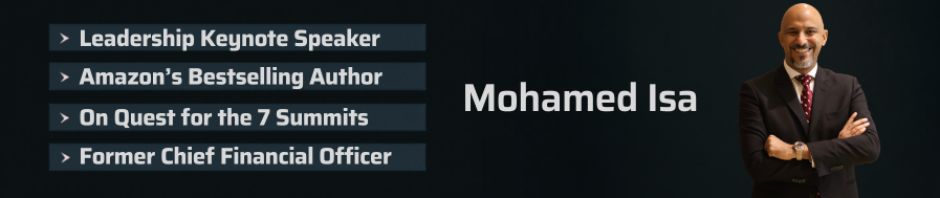
Mohamed Isa is an Amazon Bestselling Author, former CFO, and Leadership Keynote Speaker who shares leadership lessons from mountaineering. He is currently pursuing his PhD at Kathmandu University.
