
“Welcome to the Base Camp!”
That’s what my heart whispered four years ago today, on 13 May 2022. I was standing at 5,364 meters above sea level. My legs were screaming at me. My lungs were confused. And my last warm shower? That was five days ago. But honestly, none of that mattered.
It wasn’t a sigh of relief. It was a sigh of excitement. Like something had just begun, not ended.
The place buzzed with trekkers from around the world. People were hugging. Some posing for pictures. Others just sat quietly on rocks, soaking it all in, as if trying to freeze the moment in their minds.
And I thought to myself: “This is what I traveled from Bahrain to experience.”
You bet it was worth it. Every single thing. The flights. The money spent. The aching legs. The stone villages. The roaring rivers. The dizzying ups and downs. The suspension bridges. The forests. The limited food choices. The countless Dal Bhat meals. The first time I ever had garlic soup. All of it.
Looking back now, I’m still climbing. Not just mountains. But the lessons they carved into me.
That decision to trek to Everest Base Camp happened on 16 January 2022. I was scrolling through Instagram. A sponsored ad popped up mentioning EBC. Without overthinking it, I said to myself, “Why not?”
That was it. One scroll. One spark. One yes.
And that single decision? It gave birth to a signature keynote speech. It put a book in my hands. And it set me on a mission to complete the Seven Summits Challenge.
But more importantly, it taught me six leadership lessons I want to share with you. I call them the SUMMIT Framework. And before you roll your eyes at another acronym, hear me out. I didn’t cook this up in a boardroom. I learned these lessons the hard way, in below-zero temperatures and thin air.
Let me walk you through them.
S: Start Before You’re Ready
I’ve jumped from a skyscraper in Vegas. Paraglided over the Swiss Alps. Leapt out of a plane from 4,000 meters. But Everest Base Camp? That felt different. A physical and mental challenge unlike anything I’d faced before.
Can you imagine signing up for something when you don’t even know if your body can handle it?
That’s exactly what I did.

When I registered, I didn’t have a detailed plan. I didn’t know what stories would emerge from the journey. I just knew one thing: waiting for full certainty meant I might never move.
So, here’s what I did. I created a new folder on my laptop and labeled it “Everest Speech.” Inside it? A blank page. Nothing at all. Then I created another folder: “Everest Book.” Also, blank.
I had no idea what would fill them. I just knew that the mountain might whisper something worth writing down.
Years later, that blank “Everest Speech” folder became a keynote and workshops I’ve delivered in boardrooms, conferences, and auditoriums across the Gulf and beyond. The “Everest Book” folder became Everest Inspiration, a published book. The mountain whispered. And I listened.
Sometimes you don’t need a map. Just a direction. And the courage to hit “create folder.”
U: Understand That the Baggage Comes With You
Let’s be real here.
There are 8 billion people on this planet. I suspect most of them are carrying something. A weight. A wound. A worry. I’m no exception.
The timing seemed perfect when I decided to go to EBC. I had just received a good sum from a training assignment. And since I’m self-employed… I approved my own leave. How about that?
But here’s what I didn’t tell many people. I could’ve used that money to pay debts. To take care of pending responsibilities. I made a choice. A calculated gamble.
And what a gamble it turned out to be.
I did carry baggage. In fact, a big load of it. Both personal and professional. One of the biggest issues in my personal life back then is still unresolved to this very day. But I remain hopeful that it will be resolved in time.
Baggage is part of life. You don’t wait to be free of it to start something new. You carry it. You manage it. But you don’t let it clip your wings or chain your boots.
M: Make Space for Laughter
Two moments during the trek truly tested me.
The first was on the trail from Phakding to Namche Bazaar. The elevation gain was around 800 meters. And it hit us hard. It wasn’t just the altitude. It was the slow, dragging incline that made you question your legs, your lungs, and your logic.
My trekking partner during those moments was Hassan Yaqoub, from Bahrain.
What kept us going? Two things. Breaks and laughter.
Hassan looked at me at many points and said, “Mohamed, I think we deserve a break.” I never said no. And when I said, “Hassan, I think we deserve a break,” he never said no either.
If you had seen the short distance between each break, you would have laughed at us. But remember, we’re from Bahrain. A country with zero mountains. Landscapes so flat that coffee stays still in a moving car.

So, we laughed. We made jokes. We started recording funny Instagram Stories, and surprisingly, they became popular with our followers. From that day forward, I jokingly dubbed Hassan: “The Conqueror of Mountains.”
And let me be honest with you. He’s totally not!
We were also joined by Ashok, our porter. What a character. A mix of cheerleader, guide, and trickster. I’m convinced porters are trained to lift the spirits of trekkers… and to fool them gently.
Every time we asked, “How much longer?”
He’d smile and say: “40 minutes.”
He repeated that… three or four times.
Then came: “30 minutes.” Another three or four times.
Then 15. Then 5.
And that final 5 minutes? It felt like a lifetime.
But we made it. Because of each other. Because of humor. And because of the unspoken agreement that every step was still forward, no matter how small or silly it seemed.
M: Move Forward When the Path Disappears
The most unexpected emotion I experienced on the trek?
A quiet kind of fear. Not fear of heights. Not of falling. But of being lost. And not knowing if I was leading someone else the wrong way.
Let me tell you what happened.
It was on the misty trail from Tengboche to Dingboche. Again, with Hassan.
That day, our group had naturally spread out along the trail. Whether in front, middle, or tail, you eventually find your way to the same tea house. But on this day, a thick fog had settled in. The visibility was low. No network coverage. No trekkers to ask.
Hassan turned to me and asked, “Are we on the right path?”
I remembered what our lead guide, Ganesh Bastola, had told me: “You’ll cross a small steel bridge today.”
I saw it in the distance and pointed: “There it is.”
We crossed it. Then we met a Nepali lady who confirmed we were heading to Dingboche. But soon after, the path grew confusing. What’s normally a single trail splintered into multiple tracks. And it became clear that if we took a wrong turn, even by a degree, we’d end up entirely elsewhere.
That’s when Hassan asked: “What do we do now?”
I paused. And I said something that made him blink twice.
“Let’s follow the fresh yak droppings.”
He stared at me. “Are you a former scout?”
“No,” I laughed. “But this season, most yaks carry food and supplies between villages. If they’ve been this way, so must the next village.”
And we walked. Step by step. Dropping by dropping.
Until finally, we reached Dingboche.

We were number four and five in our group to arrive. Hamad, Ahmed, and Kawthar had already made it. Mai arrived shortly after us.
And we celebrated like all smart mountaineers do: with a warm cup of honey, ginger, and lemon tea.
Sometimes, the trail just disappears. And when it does? You follow instinct, humor, and a few well-placed yaks.
I: Inspire by Walking Beside, Not Ahead
Ask Mai Al Raeesi from Bahrain how she made it to Base Camp. She’ll give you many reasons. But one of the biggest? Ashok.
He motivated her all the way. When she struggled, he didn’t step back. He stepped up. At times, he carried her backpack on top of the two 15-kg duffel bags already strapped to his back.
He never complained. He never lost patience. He never let go of his smile.
That’s what true leadership looks like. Helping someone else reach heights they never imagined. Quietly. Humbly. Relentlessly.

The mountain didn’t change my definition of leadership. It just made the definition harder to forget.
T: Trust the Process, Keep Climbing
I walked into the unknown when I left my role as Chief Financial Officer (CFO) of an Investment Bank in December 2015.
It wasn’t easy. But it was necessary.
Dr. Martin Luther King Jr. once said:
“Faith is taking the first step even when you don’t see the whole staircase.”
I first read that quote on a souvenir in Washington, D.C., in July 2015. I was preparing to leave corporate life behind and fully step into a life of speaking, writing, and traveling.

That quote became a compass. And it still is. Whether I’m standing at the base of a real mountain or facing my own mental Everest.
Everest Base Camp wasn’t the finish line. It was the starting point. I’m now on a mission to complete the Seven Summits Challenge. So far, I’ve reached the summits of Mount Kosciuszko in Australia and Mount Kilimanjaro in Tanzania.
Am I fully ready for the next one? Not yet. My shiny head might be ready, but my legs need more work.
But I plan to catch up fast. With focus. With discipline. And with the fire Everest lit in me.
Even so, there are still experiences I long for. I didn’t trek to Kala Patthar, the viewpoint offering the best angle of Everest. The same majestic angle featured on Nepali banknotes. I deeply missed that.
I wish we had more time at Base Camp to meet climbers preparing for their summit push. I wanted to connect with them. Learn from them. Be inspired by them. But time, as always, was limited.
I returned to Lukla by helicopter instead of walking the trail back. My friend Ahmed Salman from Bahrain asked if we’d consider it. It was a great experience. But someday, I long to walk that trail back to Lukla. With more reflection. Less urgency.
But maybe that’s a good thing. Unfinished business means unfinished discovery. And that gives me a reason to return.
* * *
So, before you scroll on, pause and ask yourself:
What’s your Everest?
Not the one on a map. The one you’ve been postponing.
You don’t need to see the summit. You just need to say yes to the first step.
And thank me later!
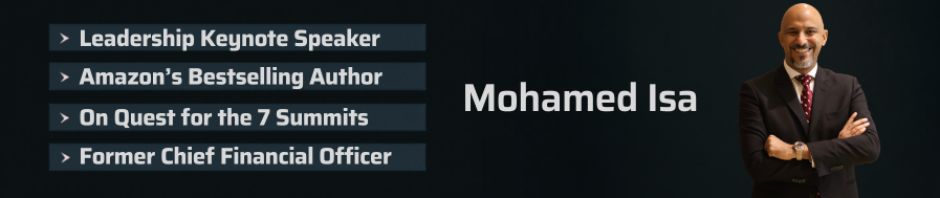
Mohamed Isa is an Amazon Bestselling Author, former CFO, and Leadership Keynote Speaker who shares leadership lessons from mountaineering. He is currently pursuing his PhD at Kathmandu University.
